Monday, May 22, 2023

Asphalt road sealant of modified asphalt material

 Asphalt pavement cracks are a common disease on the road surface. If the cracks are not treated in time, the rainwater will enter the surface layer and the base layer through the cracks, and under the action of the traffic load, dynamic water will be formed to scour the structural layer, resulting in pumping or loose base layers. Such as water damage, resulting in cracks, potholes and other diseases on the road surface.


When cracks appear on the asphalt pavement, when they are first discovered, they should be dealt with in time to prevent problems before they happen. The use of asphalt road sealant to fill joints is an effective way to deal with cracks in asphalt pavement. It is recommended that road workers take measures as soon as possible. Next, we will introduce the joint filling characteristics of asphalt road sealant, performance characteristics of asphalt road sealant and construction attention points.


1. Filling characteristics of asphalt road sealant


After the cracks are slotted and before the joint glue is injected, the slot joints must be cleaned up to prevent the asphalt road sealant from being glued to the road surface and causing the glue to open or fall off. Use a high-pressure dust blower to remove the ash, Blow the soil to ensure that the asphalt road sealant is in full contact with the road surface and increase the adhesion, so that the filling effect is good, and it can be full, smooth, clean and beautiful.


The joint filling is basically not affected by the temperature during the construction period, and it can also be constructed at low temperature; the construction method is simple, easy to operate and master; the asphalt road sealant has better quality than hot asphalt filling joints, and has a long service life. Using this crack sealing machine and process for joint filling Once, the pavement can be maintained for more than two years without refilling. Compared with traditional hot asphalt manual filling once a year, the overall cost is reduced.


With better joint filling experience in future work, the use of asphalt road sealant to fill joints on asphalt concrete pavement has certain advantages not only in joint filling quality, service life, maintenance costs, etc., but also in daily highways. It has a good prospect of popularization and application in maintenance.


polyurethane road sealant


YG road sealant in polyurethane


2. Material characteristics of asphalt road sealant


1) Water resistance. Asphalt road sealant itself is insoluble in water, does not absorb water, and can prevent water from penetrating from top to bottom;


2) Adhesiveness. Asphalt road sealant has strong adhesion to the road surface, and when the road surface is cold or thermally expanded, it can still be firmly bonded with it, and the adhesive surface will not be glued when it encounters water;


3) Elastoplasticity. Asphalt road sealant has good elasticity, and its stretching capacity meets the deformation requirements of cracks and joints, and can expand and contract with the pavement layer to ensure that it will not be broken;


4) High temperature stability. Asphalt road sealant will not flow due to heat in summer, pollute the road surface, affect the driving of vehicles, and can maintain a certain degree of toughness;


5) Low temperature flexibility. Asphalt road sealant does not harden or brittle at low temperature in winter, and maintains a certain degree of flexibility;


6) Anti-embedding. Asphalt road sealant can resist the embedding of sand and gravel debris under driving conditions, and ensure that the expansion and contraction of pavement joints is not hindered


7) Hot melt. Asphalt road sealant is a hot-melt material that can be heated repeatedly during use. The remaining materials in the joint filling equipment do not need to be cleaned, and can continue to be used after heating.


3. Points for attention in the construction of asphalt road sealant


1) Construction temperature


The construction temperature is one of the reasons for the peeling off of the sealant. If the road surface is wet and the temperature is lower than 4°C, the cohesive force of the asphalt road sealant will be reduced and it will fall off easily.


The overall temperature of the road surface is low. After the sealant is filled, the temperature drops rapidly, and the asphalt road sealant shrinks significantly. The temperature stress between the asphalt road sealant and the groove wall is relatively large, which will reduce the adhesion between the asphalt road sealant and the road surface. .


2) Crack humidity


The road surface should be dry when filling joints. If it is wet, the adhesion between the asphalt road sealant and the road surface will be reduced, causing part of the asphalt road sealant to fall off.


3) Keep it clean


Before filling the joints, use an air compressor to remove the dust and debris in the cracks after the slots and the loose objects around them to keep the cracks clean.


When cleaning cracks, in order to ensure that the asphalt road sealant and the crack wall are firmly bonded, the compressed air method and the wire brush method are often used to clean the cracks.


4) Filling range


If the rutting is serious, especially on the pavement with network cracks, it is not suitable to use this method to deal with cracks.


5) Filling material


The asphalt road sealant should have strong bonding ability with the seam wall, not stick to the wheel at high temperature, not brittle at low temperature, and have good durability.


6) Principles to be followed for joint filling


Asphalt pavement joint filling construction is to eliminate pavement diseases in the bud and achieve preventive maintenance. According to the long-term work experience, when using the joint filling machine to fill the joints on the asphalt pavement, the principle of filling the joints should be followed, so that every crack should not be missed to ensure the prevention of leakage.


When the crack width is more than 1cm, the effect of using asphalt road sealant is better, and when the crack width of asphalt pavement is less than 1cm, especially If the crack is less than 0.5cm, it is better to choose YG asphalt seam tape for seam treatment, because using YG asphalt seam tape for treatment will not cause artificial secondary damage to the asphalt pavement due to slotting, At the same time, it can also achieve the effect of partial micro-crack (healing).

Wednesday, May 17, 2023

What is concrete curb machine used for?

 Curb stone is a very important road facility, which refers to a stone object located on the edge of the road. The purpose of curbs is to separate roads and sidewalks and to protect structures, drainage systems and power lines below the road surface. In the process of urbanization, with the gradual improvement of traffic construction. The traditional way of operation and processing is realized through manual operation. Bricklayers invest a lot of personnel and have a heavy workload, and they also need to study the technical skills of the operators. Due to the technical level curve of personnel, the products produced are also good and bad, which is time-consuming and labor-intensive. Even the same personnel cannot guarantee that the quality of each processed product is qualified. The application of all synovial machines has gradually replaced manual processing.


What is a curb slipform machine?


The slipform curb machine is a machine and equipment used to build curbs and shoulders. It is often used in the construction of road curbs. The curb slipform machine can be used to lay curbs efficiently and standardizedly, and complete road construction and other work.


Prefabricated curb film machine, as the name implies, is a general term for the mechanical equipment used to construct automatic prefabricated film for curbs. Molding machine, prefabricated curb forming machine, etc. The core technology of this type of equipment is to add raw materials (cement concrete) into the hopper of the equipment, and then carry the corresponding mold according to the predetermined direction to achieve fast and high-quality sliding film operation .


Application advantages of curb slipform machine


Before the application of the curb slipform machine, the way of road curb construction was artificial prefabrication. The process of this method is relatively complicated. It is necessary to measure the construction mold first, and then carry out material preparation, mixing, mold loading, vibration, demoulding, etc. A series of work processes can prepare the curb stones, and after the curb stones are ready, they need to be installed. The whole process is complicated, lengthy, and consumes manpower and material resources.


The curb slipform machine automates this process, using machinery and equipment to complete the entire process of curb construction. There is no need to prefabricate the curb in advance. The machine goes through one molding process, which greatly saves labor costs, transportation costs, and consumable costs, and improves production. efficiency.


Working principle of curb slipform machine


The working principle of the curb slipform machine is not as complicated as imagined. The construction method is on-site pouring. After we set the relevant parameters of the equipment, the machine will continuously push the cement concrete into the mold and vibrate it through the motor of the equipment. , so that the concrete reaches a dense state, and then the curb slipform machine mold slides over the concrete road to form a strong and seamless curb. The machine equipment can repeat the action and complete the construction of the curb efficiently.


Other road construction machine


In order to meet the needs of other road construction and maintenance, YG also provides other road machinery. For example, road marking machine, thermoplastic road marking machine, manhole cover cutting machine, Asphalt Coring Machine, Shot Blasting Machine and other equipment. If you want to know more, please contact YG.

Saturday, April 8, 2023

Small outrigger down-the-hole drilling rig drilling rock

 The small outrigger down-the-hole drilling rig is suitable for large-diameter blasthole drilling in small and medium-sized mines, road construction, water conservancy and stone works, as well as drilling anchor holes in slope support,foundation pit support and tunnel support,ect. The mini rock drilling rig’s main drilling object is the rock formation. Down-the-hole drilling is based on road, railway, water conservancy, hydropower, mine construction and other projects.


The roads are inconvenient in the early stage of construction, and lifting and transportation equipment cannot directly transport the equipment to the construction site. The down-the-hole drilling rig eliminates the need for hydraulic pressure, resulting in high mechanical efficiency, low cost, and high performance. The down-the-hole drilling rig is suitable for coal mine tunneling, mine tunneling, mining, water conservancy construction, road construction and stonework. It has the characteristics of reasonable structure, convenience, easy operation and reliability.


product description

The down-the-hole drilling rig is a percussion rotary drilling rig, and its internal structure is different from that of a general rock drilling machine.  Its gas distribution and the reciprocating mechanism is the impactor. The front end connects to the drill bit directly, and the rear end is connected to the drill pipe.  When rock drilling, the impactor dives into the hole, and through the gas distribution device (valve), the (hammer body) in the impactor reciprocates to strike the shank tail, so that the drill bit generates a whirling force against the rock at the bottom of the hole. Product features: small size, light weight, suitable for places where large and medium-sized drilling rigs cannot work, convenient and flexible. The down-the-hole drilling rig is powered by electric energy, with low noise and strong power. The drilling speed of the small drilling rig is 3-8 times that of ordinary rock drills, the rock hardness reaches 9, and the drilling depth per hour is 8-16 meters.


Advantages of down-the-hole drilling rigs

1. Compact design, strong maneuverability,
2. Fast, flexible, high maneuverability, high driving force and smart design of the drilling rig make KS168 have excellent climbing ability even under harsh terrain conditions. The swing-type crawler walking device is adopted, and the walking speed is as high as 3.5 kilometers per hour. The low center of gravity design makes it more agile and stable.
3. Energy saving: switch to gear transmission output, the power is more direct and powerful, and the air consumption is 50% higher than that of the vane air motor, so as to achieve the purpose of energy saving and avoid the trouble of replacing the vane. The whole machine is suitable for engineering design, wide field of view and easy operation of the joystick, which improves the operator's comfort and production efficiency.


3. Classification method of down-the-hole drilling rigs
According to the way of walking: small outrigger down-the-hole drilling rig large crawler down-the-hole drilling rig
Divided by working power: gas-electric linkage SKD, full pneumatic
According to the wind pressure level: low wind pressure L, medium wind pressure M, high wind pressure H
According to the hydraulic power configuration of the drilling rig: diesel-powered, diesel-electric dual-purpose, electric
Fourth, the advantages of down-the-hole drilling rig
It has good drilling performance, and can effectively drill holes in hard formations, and the efficiency is very high. It is suitable for rock formations with high hardness, weathered rock formations and various hard and brittle geological environments. Disadvantages: It is difficult to remove chips, and it is very difficult to drill holes in soft geological and viscous soil layers. Use has certain limitations.


YG drilling rig manufacturer


YG engineering machine manufacturer supplies various kinds of drilling rigs.Such as,water well drilling machine,small water well drilling machine,horizontal directional drilling machine, Mineral Exploration Drilling Rigs,ect.If you want to know more machine details,pls contact us.


Thursday, March 23, 2023

Advantages of Small Excavators

 The emergence of mini crawler excavators has brought great convenience to the majority of construction workers, and it can help builders complete construction work more easily and efficiently. Small excavators are welcomed by customers for their small size and wide range of applications. The operation of the small excavator is very simple and can effectively replace manual work, greatly saving manpower and reducing the cost of manpower investment.


What types of mini excavators are there?


There are five classification methods for the classification of common small excavators, namely, according to the form of the traveling device, according to the transmission mode, according to the form of the working device, according to the driving mode and according to the purpose.


① It has a small caterpillar excavator and wheel type. The crawler excavator has a larger chassis and is suitable for complex road conditions. Therefore, its application is very extensive. The tire-type small excavator has fast walking speed and good maneuverability.


② Classification by transmission mode: There are two types: mechanical and hydraulic. Mechanical single-bucket small excavators rely on mechanical transmission and require various gearboxes, winches, wire ropes, hooks, pulleys and other parts. The structure is complex, and it has gradually been eliminated in small and medium-sized single-bucket small excavators. The hydraulic single-bucket small excavator eliminates many complicated mechanical intermediate transmission parts, simplifies the structure, improves the transmission performance, works smoothly, operates flexibly, and has high productivity.


③Classified by the form of working equipment: there are backhoe, front shovel, grab shovel, dragline and other forms. When backhoeing, the digging direction faces the fuselage, and it is used to dig the soil below the parking surface. It is flexible in work and widely used. It is the main working device form in hydraulic small excavators.


④ There are internal combustion engine-driven and electric-driven small excavators according to drive mode.

⑤According to the purpose, there are general excavators, mining excavators, marine excavators and other special excavators.


Application of mini excavator:


1. For orchards: digging fertilization ditches, planting trees, weeding, cultivating soil, opening up wasteland, etc.;


2. Trench digging: digging cable trenches, water or sewage pipelines, natural gas pipelines, etc.;


3. Landscaping: planting trees, digging ditches, etc.;


4. Mountain contracting: planting trees, repairing terraces, digging ditches, opening paths, weeding and opening up wasteland, etc.;


5. Indoor aspects: indoor demolition, basement backfill;


6. In terms of crushing: road and ground concrete crushing, mountain stone crushing, etc.;


7. Mine aspects: tunnel and cave construction, mines and shafts, etc.;


8. Vegetable greenhouses: for deep digging;


9. In terms of digging medicinal materials: for digging yams, etc.;

10. It can be matched with a variety of excavator attachments to achieve a variety of functions, for example, scrap metal shear for excavator, car dismantling shear, log grapple for excavator, ect.


In addition, agricultural and forestry planting, farmland reconstruction, small earthwork engineering, municipal engineering, road surface repair, farms, garden cultivation, and river and ditch dredging projects and other operating environments.


Features of the mini excavator:

In this era of mechanization, most users gradually use mechanized production to replace manpower. The small excavator has reliable quality and stable performance, and can adapt to harsh construction environments. The equipment is matched with a high-horsepower engine and has high construction efficiency. The structure of the equipment is simple, the operation is simple and convenient, and the maintenance cost is low. It can be matched with different excavator attachments to realize various functions such as rotary excavation, crushing, hook cleaning, bulldozing, etc., realizing one machine with multiple functions. The small excavator is suitable for various soil properties, has good use effect, simple operation, small and flexible, convenient transportation, and can work in small places.


Wednesday, March 15, 2023

What are the types of concrete pumps?

 The concrete delivery pump includes a pump body and a delivery pipe. It is a machine that uses pressure to continuously transport concrete along the pipeline. It is mainly used in house construction, bridge, and tunnel construction. With the rapid advancement of urbanization and the rapid development of urban buildings, the demand for concrete pumps is gradually increasing. YG concrete pump manufacturer offers many types of concrete pumps. We will introduce you to the machine details.

Concrete delivery pump composition

The concrete delivery pump adopts the electric motor or diesel engine to drive the pumping system, and the delivery volume of the concrete delivery pump can be automatically adjusted through the constant power control of the hydraulic system, and the concrete delivery volume can be selected by manual control. The pumping system is mainly composed of a hopper, a mixing mechanism, a concrete distribution valve, a concrete delivery cylinder, a washing room, and a main oil cylinder.

Working principle of concrete pump

When the pressure oil of the hydraulic system enters the main oil cylinder, the piston rod extends, and at the same time, the pressure oil passing through the connecting pipe of the sealing circuit makes the other piston rod retract. When the concrete conveying piston connected to the piston rod of the main oil cylinder retracts, it produces self-priming in the conveying cylinder, and the concrete in the hopper is sucked into the conveying cylinder through the suction port of the slide valve under the action of atmospheric pressure and the boost of the mixing blade. At the same time, under the action of oil pressure, the other main oil cylinder pushes the piston rod of the main oil cylinder out and at the same time pushes the concrete piston to press out the concrete in the delivery cylinder, and enters the concrete delivery pipe through the Y-shaped pipe of the delivery port of the slide valve. After the action is completed, the system automatically reverses the direction so that the pressure oil enters the other main oil cylinder to complete another suction and delivery stroke of different delivery cylinders. Repeatedly, the concrete in the hopper is continuously sucked and pressed out of the delivery cylinder and reaches the operation point through the Y-shaped pipe and the pipeline connected to the outlet to complete the pumping operation.

Types of Concrete Pumps

There are many types of concrete delivery pumps, which can be divided into the following categories according to different methods.

1. According to the way of movement: according to whether it can be moved, concrete delivery pumps can be divided into fixed concrete delivery pumps and vehicle-mounted concrete delivery pumps.

The stationary concrete delivery pump has no chassis and needs to be towed to move, while the vehicle-mounted mobile concrete pump has its own independent chassis, so it can be moved directly.

2. According to valves: According to the different valves of concrete pumps, concrete delivery pumps can be divided into tubular valve concrete delivery pumps and rotary valve concrete delivery pumps. Different design forms have different advantages and disadvantages.

3. According to the size of the pump: according to the size of the concrete pump, the concrete pump can be divided into mini concrete pump, small concrete pump, medium concrete delivery pump, and large concrete delivery pump. Usually, depending on the size of the project, concrete pumps of different sizes and models can be purchased for construction.

4. Classified according to the driving method of concrete pumps: there are piston types and extrusion types, and most of them are piston types at present. In addition, there are hydraulic diaphragm and air tank pumps.

In addition, there is a concrete mixer with pump.

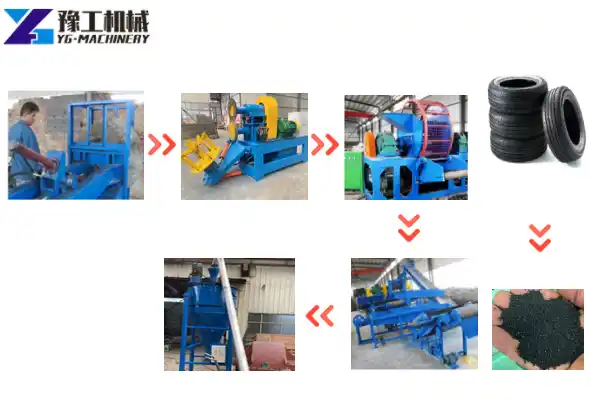
Waste Tyre Recycling Plant | Tire Recycling Machine for Sale

  Waste tyre recycling plant is a combination of equipment specially designed for processing waste tires. The line mainly contains cutting r...